

Ion Lighting
Ion LED XR 830w PRO 120v-277v
Ion LED XR 830w PRO 120v-277v
Regular price
$197.40 USD
Regular price
Sale price
$197.40 USD
Shipping calculated at checkout.
Low stock: 6 left
Quantity
Couldn't load pickup availability
Payment options
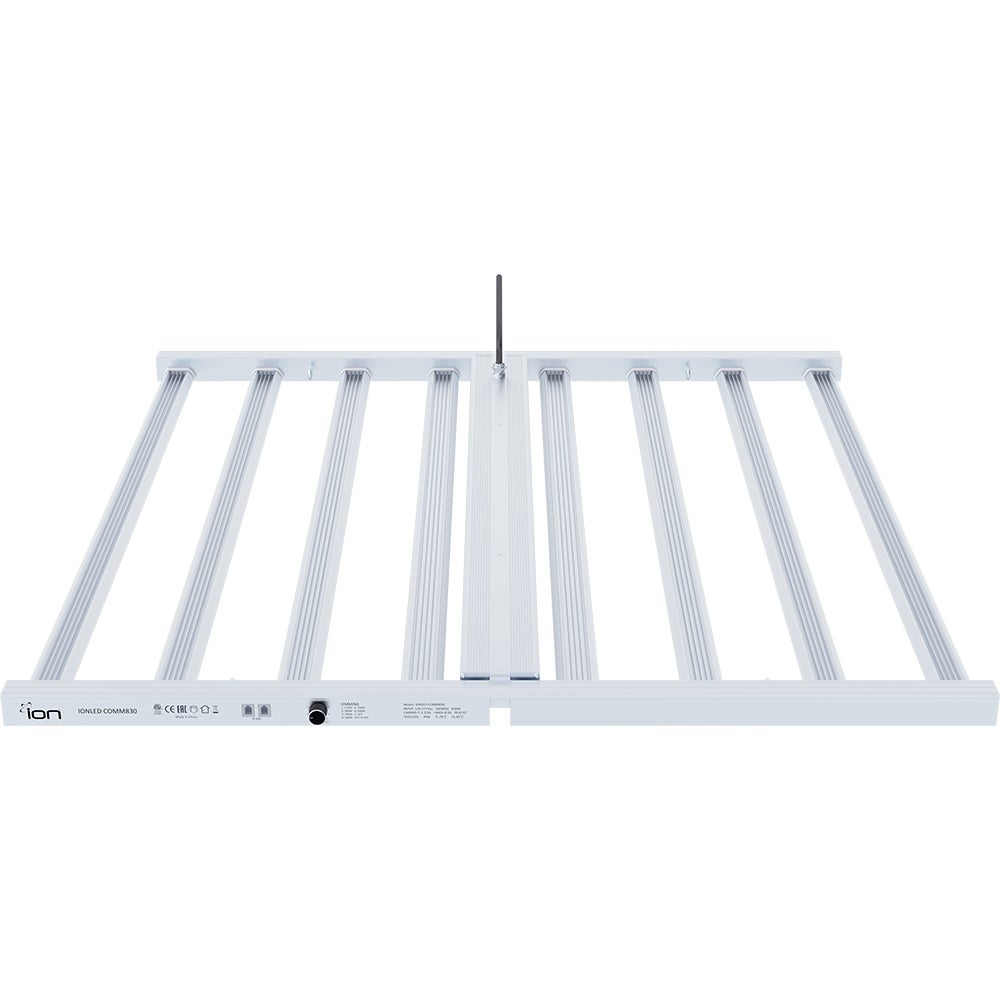
Ion has created the next generation of full spectrum commercial LED fixtures. Ion XR 830w grow lights are the most powerful LED in its class with a standard ppf of 2410 umol/s and an impressive efficacy of 2.9 mol/J per watt. The Ion XR LED was built for professional cultivators who demand the ultimate yield and quality.
PPF: 2,410 ?mol/s
Water-Resistant: IP66 Rated
Dimmable: 170W, 300W, 430W, 560W, 700W, & 830W
Random Start, Soft Start, Soft-Dimming
Foldable design for ease of transportation & installation.
Full Spectrum: FSG
The specially deployed full spectrum fills the negligence of the main photoreceptors and pigments outside the 660nm and 450nm range and it is suitable for reproduce on to aging in indoor environments which increases the radiant energy of red light at 660nm wavelength in white light . The overall color temperature of s full spectrum i FSG' s controlled at 4000K. It provides a beautiful working environment and a more realistic color reproduction degree at a CRI level of 88.

Engineered with a consistent light footprint of 5x5 to provide larger canopy coverage. The Ion 830w is IP65 waterproof UL 8800 certified and DLC certified for energy efficiency rebate eligibility. Dimensions: 45.1 in x 43.7 in x 2.4 in. Weight: 22.7 lbs.
Measured in isolation on at 100% light intensity with fixture centrally hanging at pre-determined height above a 5'x5' grow area.


PPF: 2,410 ?mol/s
Water-Resistant: IP66 Rated
Dimmable: 170W, 300W, 430W, 560W, 700W, & 830W
Random Start, Soft Start, Soft-Dimming
Foldable design for ease of transportation & installation.
Full Spectrum: FSG
The specially deployed full spectrum fills the negligence of the main photoreceptors and pigments outside the 660nm and 450nm range and it is suitable for reproduce on to aging in indoor environments which increases the radiant energy of red light at 660nm wavelength in white light . The overall color temperature of s full spectrum i FSG' s controlled at 4000K. It provides a beautiful working environment and a more realistic color reproduction degree at a CRI level of 88.
Engineered with a consistent light footprint of 5x5 to provide larger canopy coverage. The Ion 830w is IP65 waterproof UL 8800 certified and DLC certified for energy efficiency rebate eligibility. Dimensions: 45.1 in x 43.7 in x 2.4 in. Weight: 22.7 lbs.
Measured in isolation on at 100% light intensity with fixture centrally hanging at pre-determined height above a 5'x5' grow area.
- Fast Delivery
- Easy Returns
- Secure Checkout