


Front Row Ag
Front Row Ag Soft Bloom 25LBS
Front Row Ag Soft Bloom 25LBS
Out of stock
Couldn't load pickup availability
Payment options
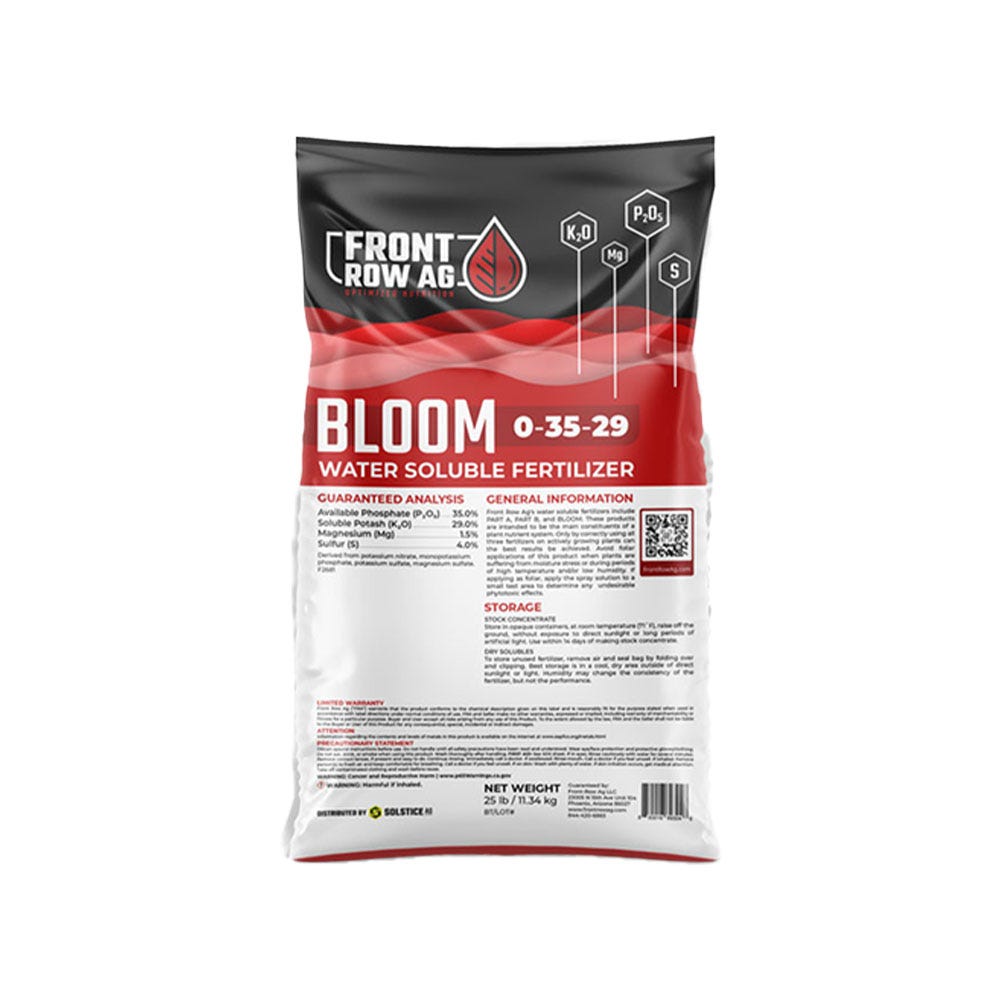
Front Row Ag Bloom formula is engineered to optimize plants for the flowering stage, promoting abundant, dense, and aromatic flowers. By fine-tuning the calcium to magnesium ratio and boosting phosphorus and potassium, Bloom fuels the surge in photosynthesis and protein production that occurs during flowering. The Front Row Ag three-part system offers growers a convenient and consistently effective approach to achieving agricultural excellence. Front Row Ag can be mixed direct to reservoir (DTR) or used to create stock solutions in a 3:2:2 ratio of Part A, Part B, and Bloom that can be injected equally throughout the flowering cycle. Both methods allow growers to easily deliver scientifically formulated nutrition to their plants. Compatible with a variety of water sources and injection equipment as well as direct-to-reservoir usage, the three-part system opens up new levels of competence in controlled environment agriculture. Front Row Ag's water soluble fertilizers include PART A, PART B, and BLOOM. These products are intended to be the main constituents of a plant nutrient system. Only by correctly using all three fertilizers on actively growing plants can the best results be achieved. Avoid foliar applications of this product when plants are suffering from moisture stress or during periods of high temperature and/or low humidity. If applying as foliar, apply the spray solution to a small test area to determine any undesirable phytotoxic effects. Combines calcium with a potent micronutrient package for an optimal Ca:Mg ratio of 5:1 to 3:1 Employs EDTA and EDDHA chelates to ensure uptake of all 8 essential micronutrients Provides nitrogen in nitrate form for easy absorption and a low salt index Designed to allow strategic Nitrogen tapering to shift resources towards plant secondary metabolism Front Row Ag Bloom 0-35-29 Guranteed Analysis Available Phosphate (P2O5)...... 35.0%/li> Soluble Potash (K₂O)...... 29.0% Magnesium (Mg)....... 1.5% Sulfur (S)....... 4.0% Derived from: Potassium Nitrate, Monopotassium Phosphate, Potassium Sulfate, Magnesium Sulfate. F2681 Front Row Ag Bloom 0-35-29 Storage STOCK CONCENTRATE Store in opaque containers, at room temperature (71F), raise off the ground, without exposure to direct sunlight or long periods of artificial light. Use within 14 days of making stock concentrate. DRY SOLUBLES To store unused fertilizer, remove air and seal bag by folding over and clipping. Best storage is in a cool, dry area outside of direct sunlight or light. Humidity may change the consistency of the fertilizer, but not the performance. Front Row Ag Bloom 0-35-29 Rate Recommendations Unless otherwise specified, use recommended rates in the following water volumes based on application method. Use sufficient volume to ensure thorough coverage and wetting needed for optimum results. STOCK CONCENTRATE INJECTION: Depending on lbs per gallon in stock concentrate, use rates are typically between 6 mL and 36 mL per gallon. For best results, make stock concentrate with source water with less than 40 ppm. It is recommended source water contains 1 - 3 ppm Cl from Calcium Hypochlorite. DIRECT TO RESERVOIR: 1-9 grams per gallon (for use directly into reservoirs and feed tanks without making concentrate). Part A contributes 0.322 EC per gram per gallon. Rates other than those suggested may be applied depending on crop conditions and cultural practices. Part A is recommended for use on (but not limited to) the following crops and areas - Field, Greenhouse, Indoor, Vegetable, Fruit and Nut Crops (such as alfalfa, almonds, apples, apricots, avocados, beans, broccoli, carrots, cauliflower, cherries, citrus, corn, cotton, cucumbers, hemp, lettuce, nectarines, onions, peaches, pears, peas, pecans, peppers, plums, prunes, sorghum, sugar beets, tomatoes, walnuts, and wheat): Apply 1-9 grams per gallon or 6-36 mL stock concentrate per gallon of irrigation water as needed. Vine and Berry Crops (such as blueberries, cranberries, grapes, hops, and strawberries): Apply 1-9 grams per gallon or 6-36 mL stock concentrate for every gallon irrigation water in early spring or when deficiency symptoms first appear and repeat as needed. Front Row Ag Bloom 0-35-29 Rate Mixing and Handling DIRECT TO RESERVOIR 1. ADD R.O. WATER - Fill RTU batch tank to final target volume 2. ADD FRONT ROW - while agitating. Wait 3-5 minutes between each component addition 3. MIX - Continue agitation, adjust pH and check solution after 5 - 10 minutes STOCK CONCENTRATE 1. ADD R.O. WATER - Fill stock tank to 50% of final volume 2. ADD FRONT ROW & MIX Start agitation, add total LBS/GAL for final volume, mix for 5 minutes 3. FILL Continue agitation while filling to final volume, mix for 10 more minutes MIXING The following mixing instructions are based on the 3-2-2 Method. Please see the HOW TO VALIDATE STOCK CONCENTRATE section and Feed Chart QR Code for the traditional values used for even injection ratios based on the 4-3-3 Method. The '#-#-#' refers to bags per drum i.e., 3-2-2 equals per 50 gallons - three-25 lbs bags Part A and two-25 lbs bags Part B and Bloom. Additionally, it is the correct dry to reservoir ratio for the products relative to each other. With constant agitation, dissolve the recommended amount of this product into approximately half the required final volume of Reverse Osmosis water. Make sure the mixing drill reaches bottom, is run forward and reverse, and creates a very forceful disturbance. Mix for at least 5 minutes. Once concentrate appears solutionized, fill the remaining 50% volume with constant agitation. Mix for at least 10 more minutes. NOTE: Part A is recommended to be used at 1.5 pounds per gallon or 681 grams per gallon of final concentrate volume. See chart in ‘How to Validate’ and Feed Chart QR code for other options. Slowly add the remaining water while maintaining constant agitation. Water quality and temperature will determine maximum solubility. Once stock solution has reached room temperature and is solutionized, mix briefly again to prevent scaling. Warmer water temperatures increase solubility and shorten dissolving time. As this product goes into solution, the water temperature will drop. Therefore, it is important when preparing concentrated solutions to compensate for this temperature drop to ensure that the fertilizer is completely dissolved. DO NOT exceed weights recommended per gallon. Accuracy should be maintained at ±1 gram. COMPATIBILITY BLOOM may be applied separately or in conjunction with most pesticides and other fertilizers. BLOOM is intended to be used with Front Row Part A and B. DO NOT use with basic metal sulfates, strong alkaline materials (such as hydrated lime and lime sulfur), oxidizers or paraffinic oils. Front Row Ag Part A, Part B, and BLOOM components each have their own stock concentrate tank. Front Row Ag Part A, Part B, and BLOOM components go direct to the reservoir in the same RTU feed tank. A compatibility test is recommended if the desired combination has not been previously used. Tank mixtures with copper-based products can be phytotoxic due to increased solubility of copper. Before general applications, apply the solution to a small test area of the foliage to determine any undesirable phytotoxic effects. All stock concentrates are designed to be made with Reverse Osmosis (RO) or demineralized water. . Recommended Irrigation Water Temperature: 68F-72F, Stock Concentrate Mixing Temperature: 71F-85F, & Stock Concentrate Resting Temperature: 71F-75F.
- Fast Delivery
- Easy Returns
- Secure Checkout
Share
INFORMATION QUESTIONS
FREQUENTLY ASKED QUESTIONS
What is Hydroponics?
Hydroponics is the science of growing plants without soil. The plants thrive on the nutrient-water solution alone. The growing medium merely acts as a support for the plants and their root systems while the solution passes freely. The growing medium, if any, is totally inert.
What types of plants grow best hydroponically?
Anything can be grown hydroponically, but some plants prove to be more space efficient. Some plants we suggest are tomatoes, sweet peppers, hot chilies, lettuce, spinach, squash, cucumbers, broccoli, beans, snow peas, herbs and flowers of all types.
Can you REALLY get better yields/quicker growth?
Absolutely. The plants, when receiving everything they need, tend to be healthier, faster growing and generally more productive. You can expect 30% faster growth with many crops.
What are the watering cycle timelines hydroponic systems?
Once the reservoir is filled with nutrients, it is time to put your hydro system to work! The ease of hydroponics is automation – automation is achieved by putting the pump on a timer according to your watering needs. The watering cycle depends on growth stage, growing medium and hydroponic system. In an ebb and flow or drip system with rockwool as the medium, seedlings, clones and plants in the early vegetative stage require watering only once a day for 15-30 minutes (twice a day for higher temps). Mature, flowering and fruiting plants require a heavier feed and can be fed once a day for 30 minutes (twice a day for higher temps). Typically soiless mixes and coco fiber can be watered for about 15 minutes twice a day, and can be adjusted for heavier feeding during the flowering and fruiting stage or higher temps. ViaStone, Hydroton, Grow Rocks, and Silicate mediums need to be watered more frequently – a constant drip for drip systems, and about 15-30 minutes every 3 hours for ebb and flow systems and can be adjusted for heavier feeding during the flowering and fruiting stage or higher temps. Aeroponic systems require frequent watering cycles; 30-60 seconds every few minutes or a constant spray.
What do I need to test pH? How do I test pH?
pH has a range from 0 (acidic) – 14 (alkaline), with 7 being neutral. A proper hydroponic pH range is between 5.5 to 6.2 for most hydroponic crops. For specific crop pH, check out our Plant Guide. pH must remain within the proper range for good plant health, disease resistance, and proper nutrient uptake. pH is maintained by adding pH Up and pH Down to the nutrient solution. For more information, see the Testssection of our site.
How will the flavor compare to my outdoor grown, organic produce?
The taste may be even better! This is simply due to the fact that the hydroponically grown plants are getting everything they need, when they need it. Don’t be fooled by “hot house” produce grown commercially. The grower’s primary concern is shipability and storage, not flavor. When you grow your own vegetables at home, you can expect nothing less than excellent results. Plus, hydroponically grown produce has the added benefit of a longer shelf life.